
XIRR Calculator
Calculate XIRR for Mutual Fund SIPs, LIC Policies, Chit Funds, Sukanya Samriddhi Yojana (SSY), ULIPs, or any Custom Cash Flow.
Import Cash Flows
Works with Zerodha, Groww & custom CSV100% local processing — your file is read by your browser only. No data is uploaded to any server.
Investment Returns Analysis (XIRR vs CAGR)
XIRR (Extended IRR)
Best for irregular cash flows (SIPs, LIC, Chit Funds). Accounts for varying dates and amounts for the most accurate annualized return.
Understanding the XIRR result: how to know if your XIRR is good or bad?
The XIRR result (in percentage) shows how your investments performed over a period, with full consideration of the timing and sequence of cash flows.
Whether it’s a SIP, ULIP, LIC, or a custom cash flow profile you select, XIRR takes into account exactly when you put money in or take money out, and how much you added or withdrew each time. That’s why it often shows a picture that methods like CAGR can’t capture. Those methods treat all your money as if it was invested at once, which can hide the real story.

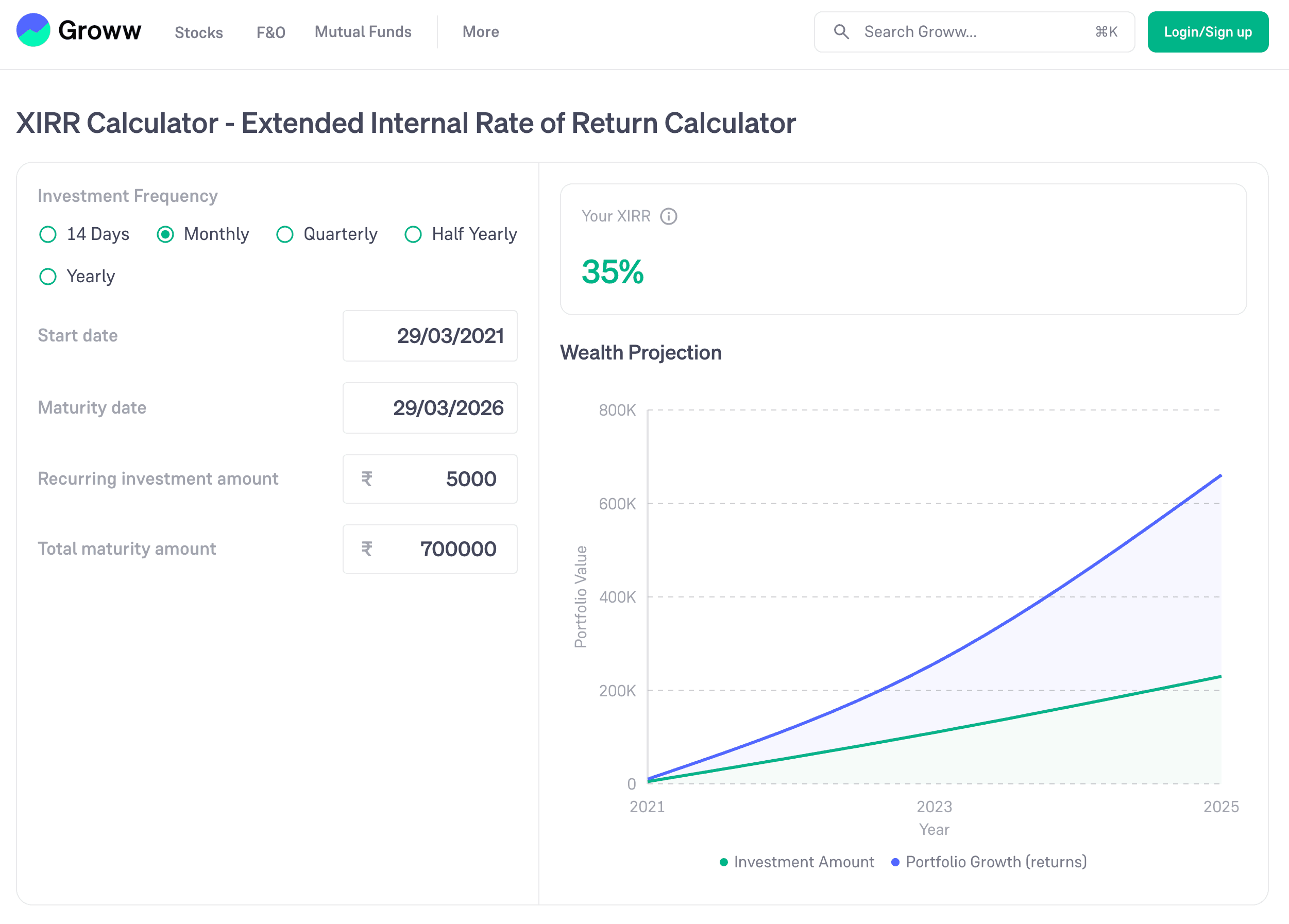
Example: Imagine you invest INR 5,000 every month in mutual funds for five years. CAGR would simply compare the total amount invested with the final value at the end, ignoring when each 5,000 was invested and whether you redeemed a few units along the way. XIRR, by contrast, considers every single cash flow and its timing, giving a result that’s closer to the actual return you experience
A higher XIRR generally signals better performance, but on its own it doesn’t tell the full story. For instance, if your investment period is under a year, the figure can swing sharply, because the returns are expressed on an annual basis. In such cases, short-term gains are effectively projected over a full year, which can distort the outcome. The measure becomes far more reliable once cash flows extend over longer periods, say 12 months or more. That’s when XIRR begins to offer a more complete and meaningful view of returns.
Is my XIRR healthy? Let’s compare It with benchmarks
XIRR calculator’s results should be benchmarked against the returns of other investment opportunities for meaningful insights. These can include mutual funds, hybrid or debt-oriented funds, fixed deposits, gold, real estate, Nifty 50 or similar indices, ULIPs, LIC policies, or custom profiles with comparable risk and duration. Looking at what these alternatives typically return gives you a much clearer picture of how your portfolio is performing.
How do we use XIRR formula to calculate the return?
I used Microsoft Excel earlier to calculate XIRR, since it is the most common tool people suggest. But Excel as you know is not very beginner friendly. First you have to install it, then enter all the dates and amounts properly, and after that make sure you select the right cells. I remember getting the formula wrong more than once, and Excel just showed an error. Even a small mistake in one entry can throw the whole result off, which can be confusing if you are new to it.
There isn’t an explicit formula for calculating XIRR and most financial tools, whether it’s Google sheets or Excel, use an iterative method, often based on the Newton-Raphson algorithm to estimate it. The general mathematical representation is as follows:
In Excel, you can use the built-in [=XIRR(cash_flows, dates, [guess])] function to calculate XIRR, Although the actual calculation of the entered data given in the cells happens in the background using an iteration formula as given above. For example, =XIRR( A1:A5, B1:B5, 0.1) calculates the XIRR based on the cash flows in cells A1 to A5 and the corresponding dates in cells B1 to B5, with an initial guess of 10 %.
Real life applications of XIRR Calculator
An XIRR calculator can be effectively used to calculate returns from SIPs (mutual funds) in both regular and irregular investment modes. It can also help you calculate your personal returns from LIC policies, ULIP insurance products, chit funds, Sukanya Samriddhi Yojana, and much more.
Calculating a Chit fund’s interest rate or return
In the initial phases of a chit, higher bids by the bidders result in larger dividends being distributed among the participants. As members bid for the chit early, the winning bidder forego a larger portion of the prize amount in exchange for receiving the fund earlier, leaving the remaining amount as a dividend to be shared by the rest of the group. This sharing reduces the monthly payments for other members, during the early stages of the Chit fund. Calculating the returns on such an investment, which involves varying payments, deduction of commissions, and sudden and early payout, is complex. An XIRR calculator can help you determine the overall return of Chit investment by accounting for the varying contributions and payouts.




why is an initial guess needed?