What is expense ratio? How to find it?
When you put money into a mutual fund, either through a lump sum or a SIP, you are trusting AMCs or fund houses to take care of your money and help it grow. The Asset Management Company (AMC) overseeing the fund, for example, ICICI Prudential Mutual Fund, charges a small fee for this service, and it is called the expense ratio. This fee is used to cover the costs of fund management, research, administration, and other day-to-day expenses involved in running the mutual fund.

In India, the expense ratio is regulated by SEBI and capped at around 2.25% per year. However, most funds charge much lower, typically around 0.8% to 1.2%, depending on the fund size and category.
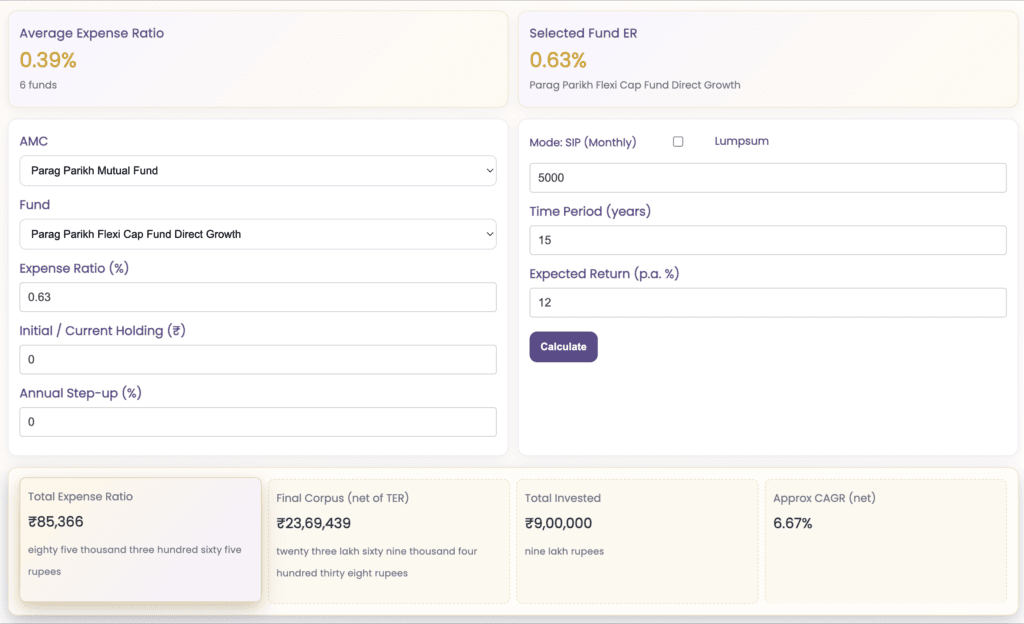
If you want to know the expense ratio charged by your fund house, you can use the Fund Selector tab of our Expense Ratio Calculator. Choose your AMC and fund, and it will list the expense ratio of that fund and the average expense ratio across all funds of the chosen AMC.
We have listed the latest expense ratios of the top 10 fund houses like SBI, Axis, HDFC, ICICI Prudential, Parag Parikh, DSP, Tata, Mirae, UTI, and Aditya Birla Sun Life for their direct plans. You can also find this information on the AMC’s website and on your distributor’s page for the fund.
Calculate Expense Ratio for SIP and Lump Sum investment
In our all-in-one SIP calculator, we have included Expense Ratio as a feature to show the effect of deductions on your long-term goals. However, in that calculator, it is an optional feature, and most of the time users do not enable it. The purpose of a general SIP calculator is mainly to project the returns, so we felt that expense ratio deserved a separate calculator for users who want to understand it in more detail.
Most expense ratio calculators out there apply the percentage directly on the final corpus, which is not accurate and can sometimes inflate the cost. In reality, expense ratio is adjusted daily through the fund’s NAV, not deducted as a one-time charge at the end. Our calculator follows this day-by-day calculation approach, so the results closely reflect how expense ratios impact SIP and lump sum investments in India.
How to use the expense ratio calculator?
- Choose the AMC from the drop-down list (for example: Parag Parikh Mutual Fund).
- Select the fund of your choice (for example: Parag Parikh Flexi Cap Fund). The calculator will immediately show the selected fund’s expense ratio and the average expense ratio of that AMC across all its funds.
- Enter the SIP amount, adjust the investment period, and set the expected return (CAGR) as per your requirement.
- Choose the annual step-up or initial investment, if you are following that strategy.
- Then, Click Calculate to see the expense ratio impact.
- This will show the total expense charged by the AMC over the investment period in the result cards.
You can also switch to Lump Sum mode on the right side. If you want to calculate the expense ratio for a lump-sum investment, switch from SIP, enter the amount in the input field that appears, and click Calculate again. In this case, the step-up and initial investment should be set to zero.
Mutual Fund Expense Ratio calculation in practice
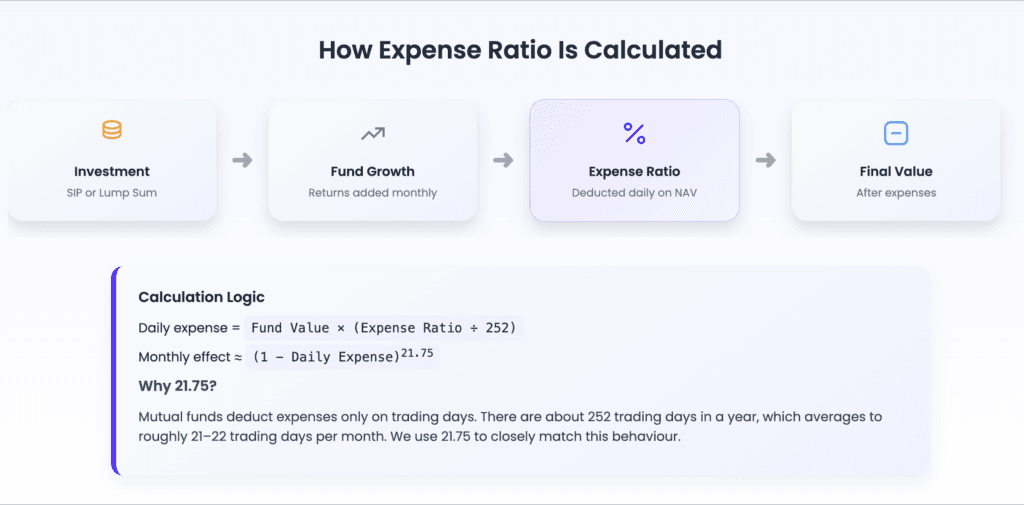
Step 1: Investment enters the market
Your SIP or lump-sum amount is invested into the fund and participates in market movements. Each trading day, the fund’s value changes based on market returns.
Fund value (before expenses) = Previous NAV × (1 + daily market return).
Step 2: NAV is adjusted for Expense Ratio
At the end of each trading day, the expense ratio is applied to the fund’s value. The annual expense ratio is first converted into a daily rate and adjusted in the NAV.
Daily expense factor = Expense Ratio ÷ 252 (number of trading days in India)
NAV (after expenses) = NAV × (1 − daily expense factor)
This deduction happens internally through the NAV adjustments, which is why investors do not see as a separate charge.
Step 3: Compound the ER impact throughout the investment period
This daily expense adjustment continues throughout the investment period and compounds over time, just like returns. For SIPs, expenses apply only to the amount invested so far. But for lump-sum investments, the entire amount is exposed to expense ratio from day one, which is why the impact is higher over long periods.
The good thing is that our calculator takes care of all these calculations in the background, so you don’t need to worry about how it works. Just enter your investment details and see how the expense ratio impacts your returns over time. Since the expense ratios of popular funds are already included, you don’t need to look them up separately. Just select the fund and hit the calculate button.
Conclusion: Why expense ratio matters?
Expense is a largely unnoticed part of mutual fund investing. This is because, unlike stock trading, where you receive a daily trade summary showing brokerage and charges, mutual funds don’t send a separate bill. Instead, the amount is internally deducted from the fund’s value every day. The NAV (Net Asset Value) changes to reflect this daily deduction. That’s why most investors never see it.
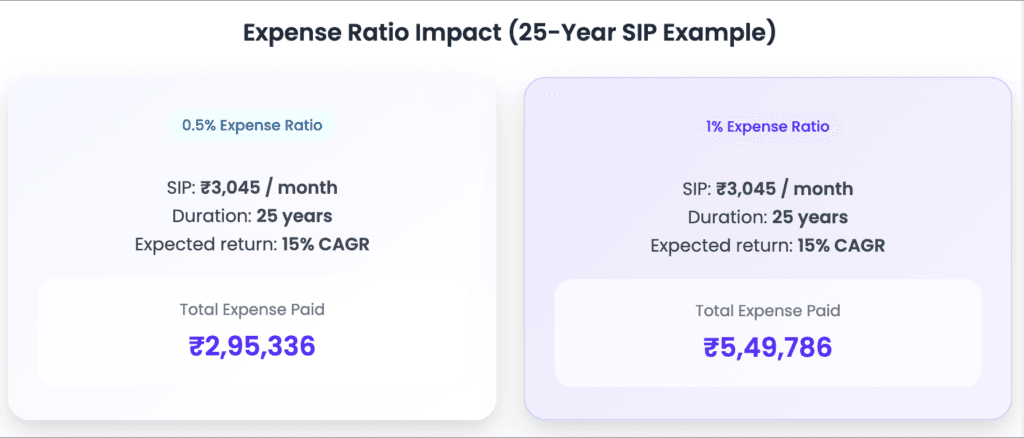
Expense ratio impact can compound over time just like returns, and even just 0.5% or 1% can erode lakhs of rupees from the SIP corpus over the long term. The impact is higher for lump-sum investments, as the full amount is invested upfront.