
8th CPC Salary Calculator App
Calculate the 8th pay commission salary increase for central government employees from Level 1 to Level 18.
Calculation Results
Expected Gross Salary (8th CPC): ₹1,26,940
Your salary will increase by ₹33,840 (36.35%)
Tax Breakdown
Final Taxable Income: ₹12,97,416
Annual Tax: ₹1,55,690
Monthly Tax: ₹12,974
Effective Tax Rate: 12.00%
In-Hand Salary: ₹1,04,286
Breakdown: ₹1,26,940 (Gross) - ₹12,974 (TDS) - ₹8,980 (NPS) - ₹700 (Other Deductions)


The Central Government has officially announced the constitution of the 8th Pay Commission, and curiosity among employees is now at an all-time high. What will the revised salaries actually look like once the new pay structure is implemented? Will higher taxes and statutory deductions offset a major portion of the expected gains? This interactive 8th CPC salary calculator app answers many of your questions.
Just enter a few details from your current 7th CPC profile, like your pay level, allowances, and mandatory deductions, and the app will give you an estimate of your 8th CPC salary. It can also make a PDF report that explains about how much tax you would pay and what your take-home salary would be.
Steps to use 8th Pay Commission salary calculator
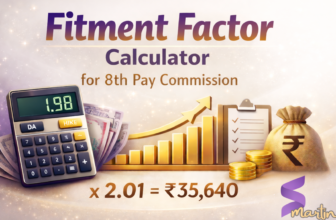
Any serving Central Government employee can easily understand the terms used in our 8th CPC calculator, particularly Pay Level, DA, TA, NPS, UPS, and so on. However, if you haven’t been keeping up with recent pay revision news, the term “fitment factor” might be confusing. The fitment factor is a number that the Pay Commission is expected to announce and submit to the Government in 2026. Choosing the right fitment factor is the most important part of any 8th CPC salary calculation. This is the number you multiply your basic pay by to arrive at the new 8th CPC basic pay and allowances.
Once you provide the fitment factor (which is obviously based on your expectation for now), the calculator will do the rest- estimating your 8th CPC basic Pay, gross salary, and take-home salary.
Now, let’s calculate the 8th CPC salary for a level 1 central govt. employee using the app, with a proper step-by-step explanation.
Step 1: Enter the current Pay Level.
The application by default loads Pay Level 7 and pre-fills the basic pay for that scale under the 7th CPC. So, as the first step, you need to change this pay level (if you are not in Level 7) to match your profile.
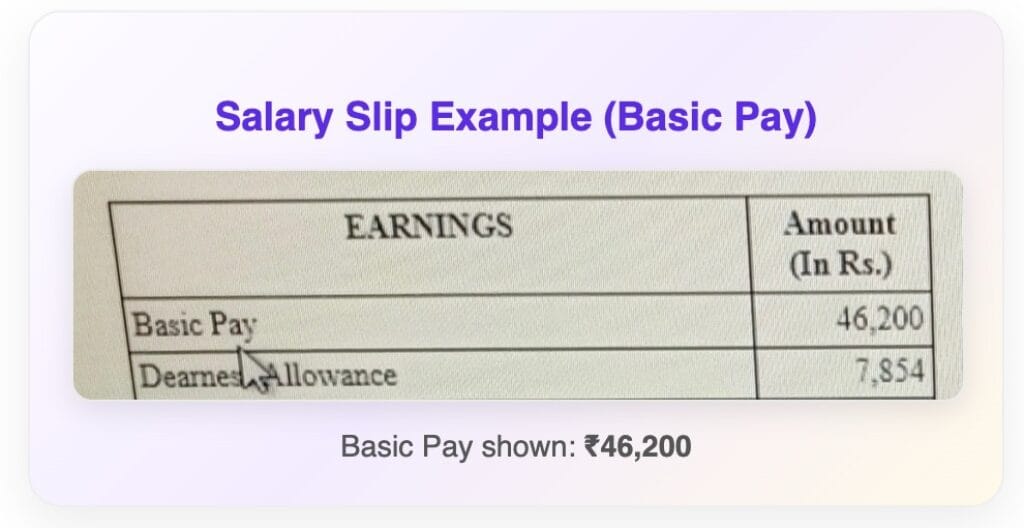
Please note that if your pay matrix level is different from the displayed one, you must edit the basic pay input field and enter the applicable value. Your salary slip will tell you the current basic pay drawn by you.
Step 2: Choose a fitment factor.
The next thing is the fitment factor, which is obviously subjective because it depends on what you believe the Government will approve. I have chosen “2” in the app, which sits between 1.5 and 2.5 – not too optimistic and not too low. And there is a reason for this selection. This is based on a simplified version of the logic the Pay Commission used (as per sources) while preparing the 7th CPC recommendations. It adds the final DA to the basic pay along with the general hike proposed by the Commission and then divides the total amount by the basic pay. Check it below
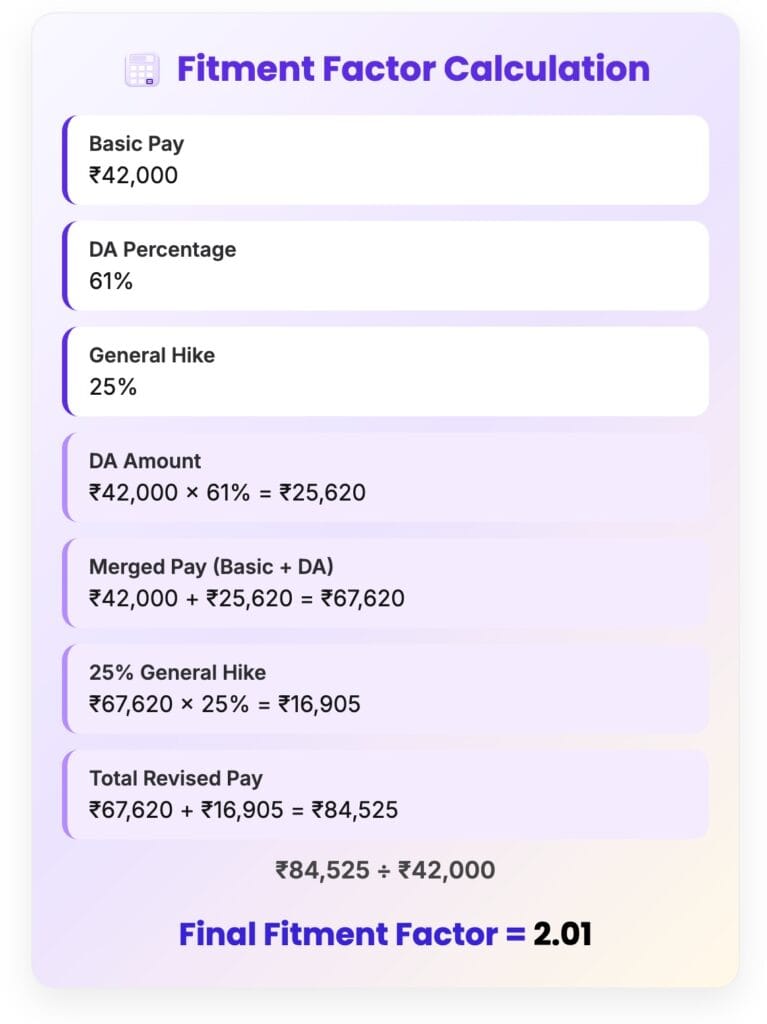
I believe a fitment factor of 2 auto-applied in the app is already generous. Why? For the 7th CPC, the Government approved only a 15% hike, but for the fitment factor calculation here, we have assumed a 25% hike. Also, the current DA is 58%, and we have used 61% assuming there will be another revision before the 8th CPC is finally implemented. Even with these optimistic assumptions, the value still comes to only around 2.01. But again, I’m leaving the final choice to your expectations.
When the fitment factor is 2, it simply means your current basic pay will be multiplied by 2.0. For example, for a Level 1 employee, the calculation would be: 18,000 × 2.0 = 36,000. This becomes the revised basic pay under the 8th CPC.
Step 3: Add up DA, HRA, TA and all the allowances.
When the 8th CPC is implemented, the DA (Dearness Allowance) will reset to zero because DA is already is being taken into account while deriving the fitment factor.
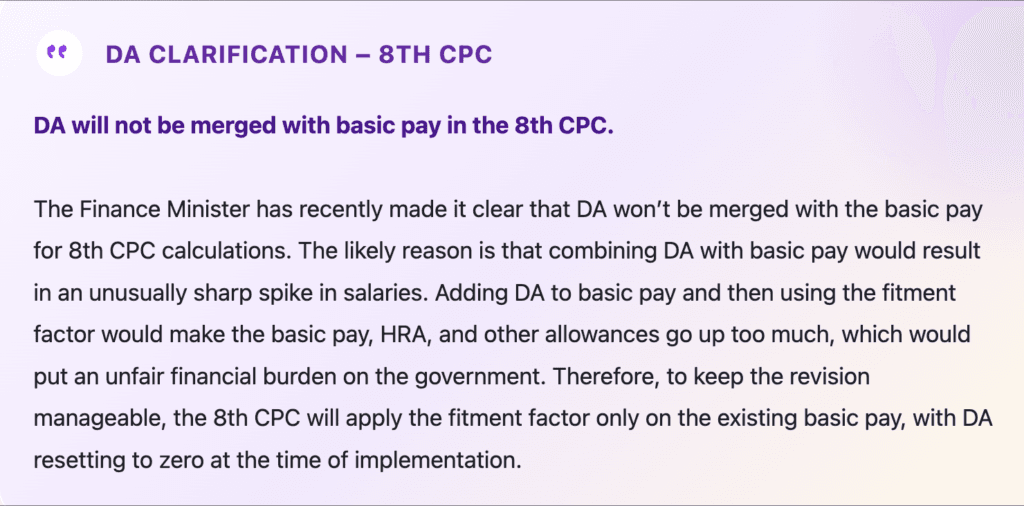
Therefore, for our calculation, we assume the DA value to be zero.
Regarding HRA, it was already revised in 2024 after DA crossed 50%. Therefore, no further HRA revision is expected at the time of the 8th CPC implementation.
In our calculator, the HRA percentage is shown near the corresponding input field and the amount in the result area. For example, a Level 1 employee working in an X-category city like Delhi will receive 30% HRA. If you work in a Y or Z category city, you can make the appropriate change using the drop-down selector. So, with a 30% HRA rate, the calculation at this point would be: 36,000 (new basic pay) + 0 (DA) + 10,800 (30% HRA).
Will there be a TA increase in the 8th CPC?
TA rates are linked to both the pay level and DA. Since DA will reset to zero under the 8th CPC, a fresh starting point for TA is expected to be announced. The original TA rates in the 7th CPC (without DA) may either be multiplied by the fitment factor or, at the very least, include the last applicable DA component to determine the new TA amount. In our calculator, the logic is currently set to multiply the existing TA rates by the chosen fitment factor 2, similar to how the revised basic pay is calculated, but you are free to adjust this value based on your preference. For example, for a Level 1 employee, applying a fitment factor of 2 would change the TA from ₹1350 to ₹2700.
After that, you can add all your other allowances such as uniform allowance, military high-altitude allowance, and any additional departmental allowances. The combined amount can be entered under “Other Allowances.” If you are eligible for qualification pay, you can include it as well. By default, we have added ₹4000 as allowances and ₹0 as qualification pay.
Step 4: Add all revised 8th CPC components to find the total increase.
If you add up the new Basic Pay, DA, TA, HRA, and all the other allowances, you get the expected Gross Salary under the 8th CPC. This amount is about ₹53,500 for Level 1 of the Central Government pay scale. Check the calculation in the following image for a detailed breakdown.
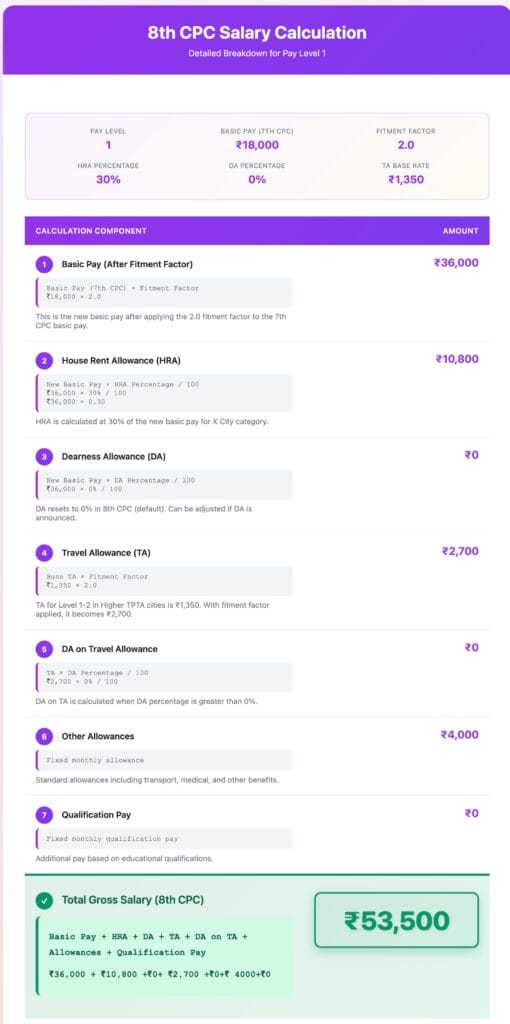
If the assumed allowances and qualification pay are not included, the starting salary in the Central Government after the 8th CPC will be around ₹50,000. However, this amount represents the gross salary only, and deductions like NPS/UPS, CGHS, and other contributions will still apply before arriving at the final in-hand salary, which we are going to calculate in the next section
In-hand salary salary calculation under 8th CPC
The Central Government now allows employees to choose between UPS and NPS pension schemes. In both cases, the deduction is 10% of the Basic Pay plus DA. Since DA resets to zero at the time of 8th CPC implementation, the initial deduction will be 10% of the basic pay. Our calculator applies this deduction while computing the in-hand salary along with other mandatory deductions such as professional tax (state-specific) and contributions to the Central Government Health Scheme. If professional tax is not applicable in your state, you can set it to zero in the calculator.
Also, if your department deducts any loan recoveries or advances directly before crediting your salary, make sure to enter those details for accurate results.
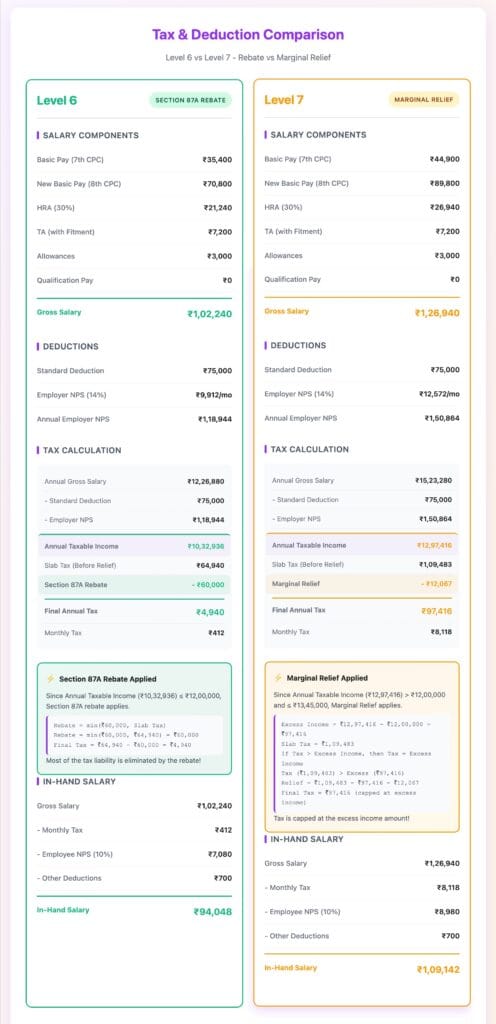
Regarding taxes, income tax generally starts impacting in-hand salary only from Level 7 onwards if you have selected the new tax regime. Until Level 6, there will be a significant benefit from the rebates available under the new income-tax rules. This is clearly explained in the following screenshot.
Download the PDF report for a detailed breakdown of the in-hand salary calculation across all the Central Government pay levels from 1 to 18.
We have added a detailed tax logic (new tax regime) in our 8th CPC calculator. It considers the Section 87A rebate and the marginal relief that becomes applicable around the ₹12 lakh limit, as per the latest income-tax rules. This is also the reason we selected Pay Level 7 as the default in our application, so that you can clearly see how marginal relief works in the result area. For example, with the Level 7 assumptions, you will notice “marginal relief applied: ₹12,067.”
Another important point is the employer’s contribution to NPS under Section 80CCD(2). It is allowed as a separate deduction from taxable income, and our calculator applies this automatically. Once you enter your pay level, it factors in the eligible 80CCD(2) deduction while computing your final tax and take-home pay.
The calculator automatically adds the deductions you enter and calculates the TDS based on your tax profile, then applies it to the gross salary to give you an idea of what your monthly salary would be under the 8th CPC.
8th vs 7th Pay Commission: Insights from our salary calculator’s projections
After studying the results of the 8th CPC calculations across all the levels, we found a set of interesting insights. First, have a look at the comparison table given below. Please note that the table assumes the default values as used in the calculator. If you have more allowances, the pay will be slightly higher than the amounts shown below.
7th vs 8th CPC Salary Increase Comparison – In-Hand Pay
Estimated in-hand salary comparison between the 7th and proposed 8th Central Pay Commission across all pay levels, showing monthly and annual increases.
| Level | 7th CPC | 8th CPC | Increase (₹) | Increase (%) | Annual Gain |
|---|---|---|---|---|---|
| Level 1 | ₹35,429 | ₹48,200 | +₹12,771 | +36.0% | +₹1,53,252 |
| Level 2 | ₹38,701 | ₹52,760 | +₹14,059 | +36.3% | +₹1,68,710 |
| Level 3 | ₹45,355 | ₹61,580 | +₹16,225 | +35.8% | +₹1,94,695 |
| Level 4 | ₹51,899 | ₹70,700 | +₹18,801 | +36.2% | +₹2,25,612 |
| Level 5 ⭐ | ₹58,270 | ₹79,580 | +₹21,310 | +36.6% | +₹2,55,715 |
| Level 6 | ₹68,947 | ₹94,048 | +₹25,101 | +36.4% | +₹3,01,218 |
| Level 7 | ₹85,306 | ₹1,09,142 | +₹23,836 | +27.9% | +₹2,86,034 |
| Level 8 | ₹89,955 | ₹1,13,364 | +₹23,408 | +26.0% | +₹2,80,901 |
| Level 9 | ₹1,03,183 | ₹1,28,837 | +₹25,654 | +24.9% | +₹3,07,853 |
| Level 10 ⚠️ | ₹1,09,096 | ₹1,33,949 | +₹24,854 | +22.8% | +₹2,98,247 |
| Level 11 | ₹1,18,670 | ₹1,53,716 | +₹35,046 | +29.5% | +₹4,20,549 |
| Level 12 | ₹1,32,718 | ₹1,72,630 | +₹39,912 | +30.1% | +₹4,78,949 |
| Level 13 | ₹1,86,957 | ₹2,48,117 | +₹61,160 | +32.7% | +₹7,33,926 |
| Level 14 | ₹2,12,791 | ₹2,84,072 | +₹71,281 | +33.5% | +₹8,55,371 |
| Level 15 | ₹2,59,317 | ₹3,48,824 | +₹89,507 | +34.5% | +₹10,74,087 |
| Level 16 | ₹2,87,722 | ₹3,88,357 | +₹1,00,635 | +35.0% | +₹12,07,618 |
| Level 17 | ₹3,11,719 | ₹4,21,755 | +₹1,10,036 | +35.3% | +₹13,20,430 |
| Level 18 | ₹3,42,328 | ₹4,64,355 | +₹1,22,027 | +35.6% | +₹14,64,322 |
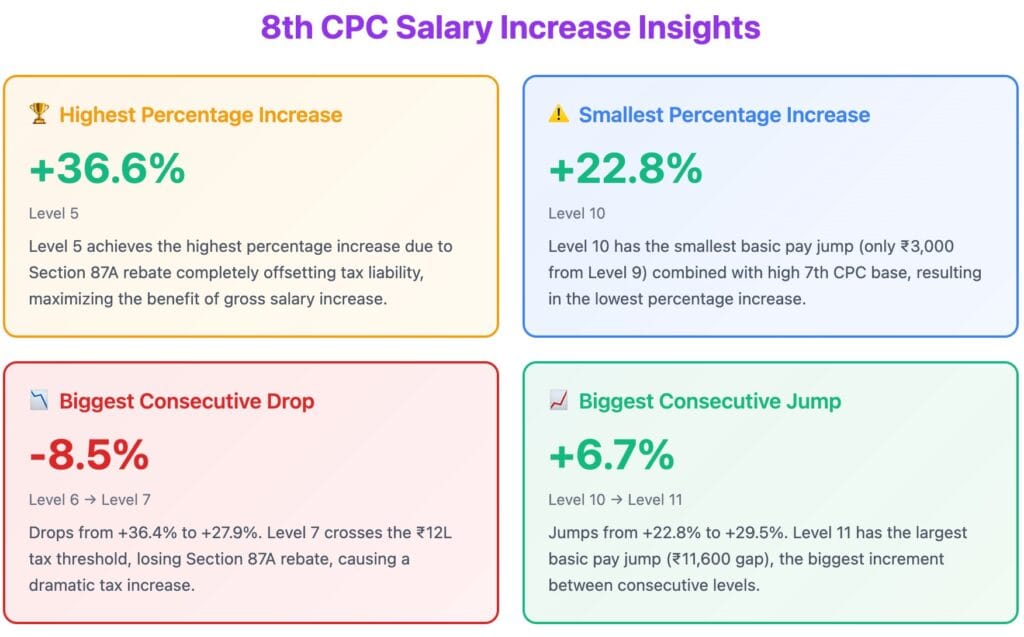
If you check the table, the highest increase in salary (in percentage terms) for any pay level in the 7th CPC compared to the 8th CPC is observed between Level 1 and Level 6, especially at Level 5, and then again between Level 11 and Level 18. There is a noticeable dip in in-hand salary from Level 7 to Level 10 due to the impact of taxes, which start applying around the ₹12 lakh annual salary range. Check the following image for explanations.
Another insight I would like to share is the effect of choosing between NPS or UPS (Unified Pension Scheme) in the calculator. If you choose NPS, the in-hand salary will be slightly higher, while under UPS it will be slightly lower because the government’s contribution is apparently less in UPS.
Therefore, if you have already switched to UPS, your take-home salary could be a bit lower under the 8th CPC. If you believe the sources available so far, under UPS the employer contribution that is treated as taxable is up to 10%, and the remaining 8% that is promised is expected to go to the pool corpus. Since UPS does not offer the extra 4% 80CCD(2) tax benefit available under NPS, this further affects the taxable income and the final in-hand calculation, especially for levels where income falls above the rebate threshold.
We are still trying to understand how the new labour laws will be applied to Central Government salary calculations. Once there is clarity, we will update the calculator to reflect those scenarios accurately.
Feel free to share your suggestions and feedback in the comments – the app will continue to improve based on what you tell us.